




Garissa Unveils Ambitious Blueprint to Protect Its Most Vulnerable Residents Ahead of Historic Launch.


By ASAL Post Editorial Desk
Garissa County is set to make history tomorrow with the official launch of the Garissa County Social Protection Policy 2026, a landmark framework designed to tackle poverty, vulnerability, inequality, and climate-related shocks affecting thousands of residents across the county.
The policy, spearheaded by the Department of Gender, Social Services and Sports under the leadership of Acting Director of Social Services Bilal Osman Mohamed, represents one of the most comprehensive county-led social protection initiatives ever undertaken in Northern Kenya.


County leaders describe the policy as a transformative roadmap that seeks to move Garissa beyond emergency relief and humanitarian assistance towards long-term resilience, inclusion, and sustainable development.
More importantly, the policy places people at the center of development, ensuring that vulnerable individuals and households receive the protection and support necessary to live with dignity, security, and hope.
A County Facing Extraordinary Challenges
To appreciate the significance and ambition of this policy, one must first understand the realities facing Garissa County.


Covering approximately 44,753 square kilometers of predominantly arid and semi-arid land, Garissa is home to more than 950,000 residents, making it one of Kenya’s largest counties by landmass and population.
Yet despite its strategic importance, the county continues to face some of the country’s most severe socio-economic challenges.
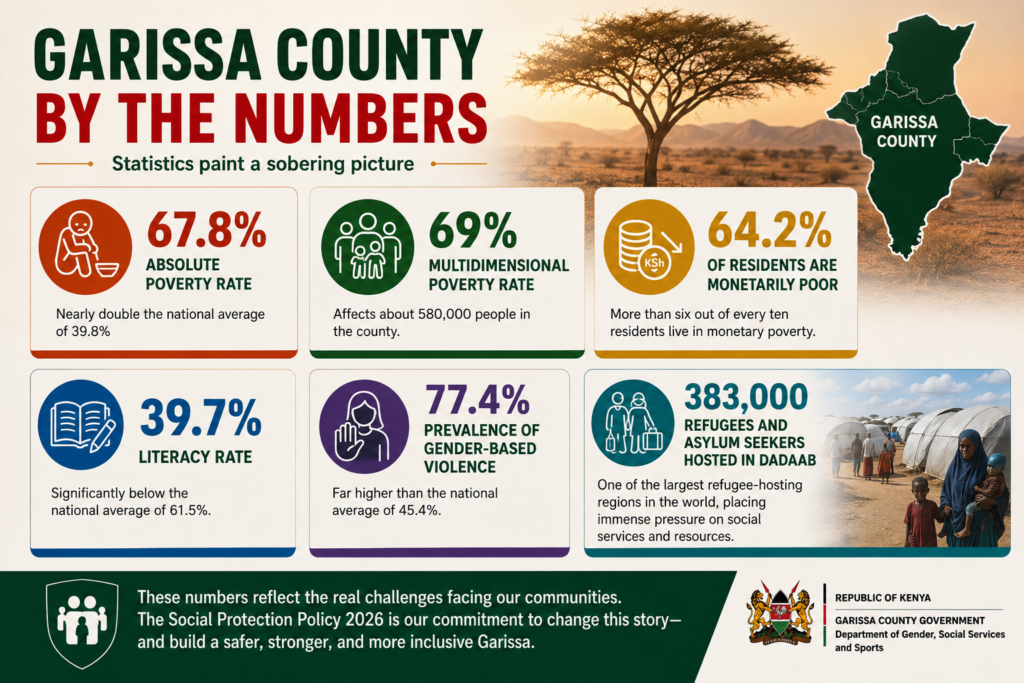
Statistics paint a sobering picture:
- 67.8% absolute poverty rate
- 69% multidimensional poverty rate
- 64.2% of residents are monetarily poor
- 39.7% literacy rate
- 77.4% prevalence of Gender-Based Violence
- 383,000 refugees and asylum seekers hosted in Dadaab
These figures reveal a county grappling with persistent poverty, limited access to opportunities, and recurring humanitarian pressures.
The county’s vulnerability is further compounded by climate change. Frequent droughts, floods, livestock losses, and environmental degradation continue to undermine livelihoods and push households deeper into poverty.

According to the policy document, more than 72,600 pastoralist households have lost their primary source of livelihood due to livestock deaths and unproductive land, while prolonged drought has displaced tens of thousands of households across the county.
Without a coordinated social protection framework, many vulnerable households remain trapped in cycles of poverty and dependency.
The Weight of Hosting One of the World’s Largest Refugee Populations
Garissa’s social protection challenge is unique.
The county hosts the Dadaab Refugee Complex, home to approximately 383,000 refugees and asylum seekers, making it one of the largest refugee-hosting regions in the world.
While humanitarian assistance has helped support displaced populations, the growing demand for healthcare, education, water, sanitation, livelihoods, and social services continues to place significant pressure on host communities and county infrastructure.
The new Social Protection Policy acknowledges these realities and seeks to strengthen social cohesion by promoting inclusive interventions that support both refugees and host communities.
The policy further aligns with national and international efforts aimed at promoting refugee integration, peaceful coexistence, and shared prosperity.
Healthcare and Social Inequality Remain Major Concerns
The policy also confronts alarming health and social indicators that continue to affect vulnerable populations.
Healthcare access remains among the lowest in the country. Only 31.2 percent of women receive the recommended four or more antenatal care visits, while childhood immunization coverage has declined significantly in recent years.
Women, children, persons with disabilities, the elderly, and marginalized communities continue to face barriers in accessing healthcare and social services.
Equally concerning is the prevalence of Gender-Based Violence.
At 77.4 percent, Garissa’s GBV prevalence rate is significantly higher than the national average of 45.4 percent. Cases of domestic violence, child marriage, defilement, female genital mutilation (FGM), trafficking, and exploitation continue to affect thousands of women and girls across the county.
The policy recognizes that addressing these vulnerabilities requires not only social assistance but also stronger legal protections, awareness campaigns, psychosocial support services, and economic empowerment programmes.
Four Pillars to Build a Stronger Garissa
The Garissa County Social Protection Policy 2026 is anchored on four strategic pillars designed to address vulnerability while building resilience and opportunity.
1. Income Security
The first pillar focuses on strengthening economic security for vulnerable households through social assistance programmes, cash transfers, livelihood support, enterprise development, and financial inclusion.
Special attention will be given to children, youth, women, persons with disabilities, refugees, survivors of gender-based violence, and the elderly.
The county also plans to support livestock restocking programmes, pasture development initiatives, agricultural support interventions, and access to affordable financing for vulnerable groups.
2. Social Health Protection
The second pillar seeks to expand Universal Health Coverage by increasing enrollment in social health insurance schemes and ensuring vulnerable households can access essential healthcare services without financial hardship.
Special focus areas include maternal health, nutrition support, disability services, mental health care, emergency referrals, and healthcare access for marginalized populations.
The policy envisions a future where no resident is denied healthcare because of inability to pay.
3. Shock-Responsive Social Protection
Recognizing Garissa’s exposure to droughts, floods, disease outbreaks, displacement, and other emergencies, the policy introduces mechanisms for rapid response during crises.
These include early warning systems, emergency cash transfers, supplementary feeding programmes, school feeding initiatives, psychosocial support, and disaster recovery interventions.
The objective is to help households recover quickly from shocks without falling deeper into poverty.
4. Complementary Programmes
The final pillar focuses on long-term wellbeing through education support, skills development, social inclusion, youth empowerment, refugee-host community integration, and promotion of social cohesion.
County leaders believe these interventions will help communities transition from dependency to self-reliance while creating sustainable pathways out of poverty.
A New Era of Coordination and Accountability
One of the policy’s most significant innovations is the establishment of formal coordination structures to oversee social protection programmes across the county.
Historically, many interventions have been implemented by different actors—including government agencies, humanitarian organizations, NGOs, faith-based institutions, and development partners—often with limited coordination.
The new framework establishes county, sub-county, ward, and village-level structures to improve planning, monitoring, accountability, and resource mobilization.
It also proposes the establishment of a Social Protection Management Information System that will strengthen beneficiary registration, targeting, monitoring, and service delivery.
County officials believe these measures will improve efficiency, reduce duplication, and ensure resources reach those most in need.
The Executive’s Vision for the Future
County leaders view the policy as more than a social welfare programme.

They see it as a long-term investment in Garissa’s future.
The policy seeks to create a society where poverty does not determine access to healthcare, education, livelihoods, or opportunities; where vulnerable populations are protected from shocks; and where social protection serves as a foundation for inclusive development.
For Acting Director of Social Services Bilal Osman Mohamed and the technical team behind the policy, tomorrow’s launch represents the beginning of a new chapter in Garissa’s development journey.
It is a vision that places people at the center of governance and development while ensuring that no resident is left behind.
Partnership at the Heart of Success
The Garissa County Social Protection Policy 2026 is not merely a county government initiative—it is the product of strong partnerships, shared expertise, and collective commitment.
The County Government of Garissa has worked closely with the National Government of Kenya, development partners, humanitarian agencies, civil society organizations, faith-based institutions, and community groups throughout the policy development process.
Among the key partners supporting social protection interventions in the county is the World Food Programme (WFP), whose work in food security, nutrition, resilience-building, climate adaptation, and cash transfer programming continues to support thousands of vulnerable households.
The United Nations Children’s Fund (UNICEF) has remained a critical partner in advancing child protection, education, health, nutrition, and social welfare programmes that directly impact vulnerable children and families.
The United Nations Development Programme (UNDP) has played a significant role in strengthening resilience, governance, climate adaptation, and sustainable development initiatives that contribute to poverty reduction and community empowerment.
The county also recognizes the contribution of the Pastoralist Girls Initiative (PGI), whose efforts in promoting girls’ education, protecting vulnerable children, empowering women and girls, and addressing harmful social practices continue to transform lives across Garissa.
Equally appreciated are humanitarian agencies, local and international NGOs, faith-based organizations, community-based organizations, philanthropic institutions, and development partners whose investments in livelihoods, health, nutrition, education, disability inclusion, refugee support, and emergency response have strengthened the county’s social protection landscape.
County officials acknowledge that the successful implementation of the policy will require sustained collaboration, innovation, resource mobilization, and community participation.
The launch therefore represents not only a milestone for the County Government of Garissa but also a celebration of the partnerships that continue to improve lives and create opportunities for communities across the county.
Beyond Tomorrow’s Launch
The true measure of success for the Garissa County Social Protection Policy will not be tomorrow’s ceremony, but the impact it delivers in the years ahead.

If fully implemented, the policy has the potential to transform the lives of thousands of vulnerable households, strengthen resilience against climate shocks, improve access to essential services, reduce inequalities, and create new pathways to economic empowerment.
In a county frequently challenged by poverty, displacement, climate crises, and social vulnerability, the policy offers something increasingly valuable: a roadmap from vulnerability to resilience.
As Garissa prepares for tomorrow’s historic launch, expectations are high that this ambitious blueprint will help build a safer, stronger, and more inclusive future for all.
For Every Person. Every Family. Every Time.


